Showing posts with label paul hollywood. Show all posts

Wednesday, 18 September 2013

Sunday brunch – brioche, part 2

It was SD's birthday this Sunday, so I decided to do something a bit special. Buoyed by the success of the brioche I made a few months ago, I decided to try the Brie and apple varieties.

The initial dough is really easy to make – dump the ingredients in the bowl (in order), pop in your dough hook and then wait.

Luckily, each of these recipes from Paul Hollywood’s How to Bake uses half quantities (or can use half quantities), so you can easily make savoury and sweet versions for breakfast.

Apple brioche

I made the dough on Friday night (10-15 mins), prepared it (about 30 mins, including making the crème patissiere) it on Saturday night and baked it on Sunday morning, but you could do it all starting the afternoon before. I promise that it is worth the small effort.

Once you’ve got your dough ready to start preparing (so, you’ve let it prove for 7 hours), divide it in two.

For the Brie version, knock the dough back a bit. Divide it into 7 equal-sized pieces. Take 100g of Brie and cut it into 7 pieces – I used Camembert in the end. Push a piece of cheese into the centre of each piece of dough. Grease a 20cm round tin, and arrange the dough balls in it, with one in the centre and the remaining 6 pieces around it. Cover the lot with some cellophane and leave it to rest for at least two hours.

The uncut Camembert brioche
When you’re ready to bake, heat the oven to 190° and bake your bread for 20-25 minutes (mine was slightly over-baked and therefore a little dry). Serve it while it’s still slightly warm. While you’re tucking into it, you can bake the apple version.
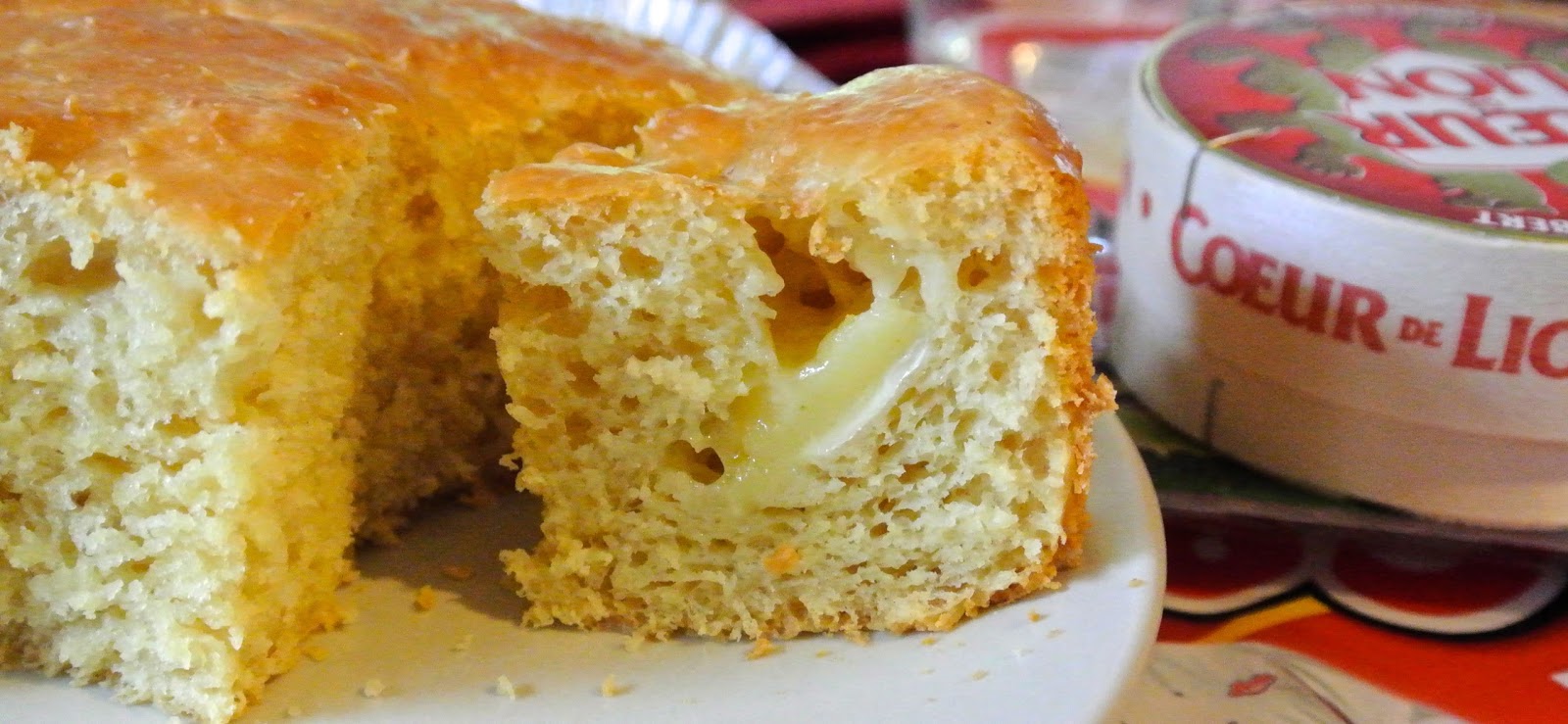
Camembert brioche

For the apple version, grease a baking sheet. Knock your dough back a bit and divide it into two. Either roll or push each one into a round shape on the baking sheet.

You’ll need to make a crème patissiere to go on top of the dough. In a bowl, combine 100g sugar, 4 medium egg yolks and 40g of cornflour until they are smooth. Heat 500ml of whole milk and a teaspoon of vanilla bean paste in a pot until boiling. Pour about a quarter of this into the egg yolk mixture and whisk. Then add this mixture back into the milk in the pot and heat the whole lot until it starts thickening. Pass this through a sieve and mix through a 40g knob of butter. Cover this with a circle of greaseproof paper to prevent a skin from forming. Leave this to cool.

When it’s cool, spread the crème on the dough – I only needed about half of it, which was fine, as this was the best custard I’ve ever eaten. And I’ve eaten a lot of custard.

The 'creme pat' on the brioche

Peel, core and slice about 3 apples and arrange these on top of the crème patissiere. If you have some, sprinkle a few slivered almonds on top. Bake this at 200° for 20-25 minutes until it is golden brown. You could brush the top with apricot jam to glaze it. I don’t like apricots, so I didn’t.

And spread with the apples

I didn’t try this, but I think some fried lardons would work well in the cheesy ones (and I’d add a bit more cheese, so maybe 150g cheese instead of 100g), and an apple and Brie version would be delicious. Hmmm, I might have to make this a third time…


Sunday, 24 March 2013

Sunday brunch – homemade brioche


We had freshly baked brioche for brunch this morning. It was melt-in-the-mouth delicious, and very, very light. I made the dough yesterday, so all I had to do was pop it in the oven when I got up.

Brioche

I used Paul Hollywood’s recipe from ‘how to bake’. It is seriously good. I’ve made a few recipes from the book now, and all have worked perfectly and taste great.

You will need:
500g strong, white flour
7g of salt
50g of castor sugar
10g of instant yeast
140ml of warm, full fat milk
5 medium eggs
250g of soft, unsalted butter

Get your mixer out, and add the flour to the bowl. Put the salt and sugar to one side and the yeast to the other. Pour in the milk and the eggs, and mix on a slow setting for about two minutes. Turn up the power to medium and mix at this speed for another 6-8 minutes, until your dough is elastic and soft.

Cut your butter up into squares and add this to the dough, mixing it well for about another five minutes. Stop the mixer every now and again to scrape down the sides. Make sure that the butter is well mixed though. Your dough should be smooth and very soft. I’ve been trying to think of what the texture is like. This was my first time making a rich dough. All I can think of is, it reminds me of soft butter. The colour and smell were divine, and the texture was very soft.

Tip the dough into a plastic container. I’m usually quite open to interpreting recipes (sometimes very liberally), but the recipe says a plastic container, so I followed it to the letter. I don’t know if you could keep it in the mixing bowl and get the same results (mine is metal). If you know better than I do, let me know in the comments below! Cover the dish and chill it for at least seven hours.

After the seven hours, the dough had metamorphasised. The squishy dough had firmed up significantly and it was much easier to manipulate.

You’ll need to grease a 25cm round tin at this stage. It doesn’t need to be lined.

Flour your work surface and tip your dough out onto it. Fold it over onto itself a couple of times to knock some of the air out. Divide it into nine similar-sized pieces. Eight of these can go around the edge of your tin, and the ninth goes into the centre.

Balls of brioche, ready to prove

Cover this with a clean plastic bag or clingfilm and leave it to prove for another 2-3 hours. I did all of this on Saturday afternoon and left the dough to prove overnight in my kitchen. Your dough should rise again.

When you’re ready to bake, heat your oven to 190°c. Bake your dough for 20-30 minutes – mine took about 35 minutes. When it’s done, put it on a wire rack to cool for a bit. We ate ours still warm from the oven with raspberry jam.

Baked brioche

Thursday, 6 December 2012

Christmas is coming! Paul Hollywood's Christmas buns


Christmas is fast approaching and to celebrate the season, I made these Christmas bun’s from Paul Hollywood’s ‘How to Bake’ at the weekend.

Christmas buns
The list of ingredients looks long, but you probably have most of these knocking around your cupboards, or at least some good substitutes.

I ended up making them with wholemeal flour, thanks to some short-sightedness in the supermarket <<must go to Specksavers>>.  The dough was a bit – dense – but this could also be because I baked them in a 20x20cm tin and they didn't have a lot of room to expand in.  They were all eaten pretty quickly.

Dough:
300ml full-fat milk
40g softened butter
500g strong white flour
10g salt
10g instant yeast
1 egg

Filling:
25g melted butter
75g soft brown sugar
2 teaspoons ground cinnamon
100g dried cranberries
100g dried apricots (I am not a fan of apricots so I used 100g of raisons AND 100g of pistachios, so I'd 300g of filling in all instead of 200g. Hey, it's Christmas)

Extras:
75g (or 9 half-teaspoons) apricot jam (I used some rhubarb jam I had in the fridge)
100g icing sugar
1 tablespoon of hot water
the fine zest of a lemon

Warm the milk and the butter in a saucepan until the butter melts and the mixture is lukewarm.

If you haven’t already, wash your hands.  Then, in a large bowl, mix the flour and the salt and then add the yeast. Mix in the milk and the egg with your hands until the dough starts coming together. 

Flour your worktop and tip the dough onto it and knead it until it’s smooth and soft. This should take about 5-10 minutes. If you start getting tired, you’re kneading the dough too intensely, so lay off a little ;-)

Oil the bowl and put the kneaded dough back in. Cover it with clingfilm and leave in a warm place to rise until it’s doubled in size, which should take an hour or two.

When you’re ready to start working again, line your baking tray with some baking paper. As I said, I used a tin which is about 20x20cm, which was too small.

On your floured counter top, shape the dough into a rectangle about 30x20cm – your dough should be about 5mm thick (about the thickness of a coin).  The 30cm side should be nearest you. Stick this side down by pushing the dough into your counter top.

Rolled out Christmas buns dough

Brush the dough with the melted butter, then sprinkle this with the brown sugar, cinnamon and then the dried fruits and nuts.  Leave about 1-2cm clear at the side nearest you – as you roll the dough up, the filling will push in front of the sausage and this gap means that you waste as little filling as possible.
With all the filling - and the 1-2cm gap 
Right, time to roll. Take a deep breath and take the edge of the dough furthest away from you and fold it about 2cm in to start the roll. You have to roll pretty tightly, so don’t be afraid. If the roll is too loose, all the filling falls out. Keep going until you’ve got a sausage shape.

When you’ve got your sausage, divide it into 9 pieces. Place these, cut side up, onto your prepared baking tin, cover with a towel and leave to relax for 30 minutes.
Relaxed dough ready to go into the oven
After your 30 minutes, heat your oven up to 190°C. Bake the buns for 20-25 minutes.

When the buns are done take them out of the oven and put them n a cooling rack. While they are still warm, heat the jam slightly in your microwave and brush the tops of the buns with it. Make your icing by mixing the icing sugar with the water in a cup and trickle this over the buns.

The buns are quite deep – about 5-6cm high, so if you prefer a more Danish pastry sized treat, cut the sausage into more pieces and use a bigger baking tray.

Photos were all taken with my phone, so apologies for the bad quality!


Tuesday, 25 September 2012

The Great British Bake Off / How to Bake


I know that a lot of people are glued to their TV screens every Tuesday evening for the Great British Bake Off. Some are there for the baking, some are there for the competitive element; some are even there for James (no, I don’t get what all the fuss is about either…) but I reckon that most of us are there for the delectable Paul Hollywood. And the cake, of course. Oh, Mr H, you can squeeze my muffins any time!
We are now at episode 6 of series three, and the competition is heating up. You can see that the contestants are still friendly with each other, but there is a certain fatigue and sense of competition seeping in. Ooooh I love this part of a competition. Muahahahahahhahahaaa.
Anyway, aside from my lusting after Mr H, I’m also lusting after all the goodies they bake on the show. This week was a complete disaster for my diet saw my cooking fantasy list explode, with sticky toffee pudding, steamed apple pudding and a host of others all joining it, in the hope of being made (again) soon.
I bought Mr H’s book ‘How to bake’ and had time this weekend to make a couple of his recipes. It was almost like having him in the kitchen. I tried his fougasse and scones (sc-own-s please, not sc-on-s. I’m Irish).
Me and my own homemade scones are not a success story. They always end up like biscuits. Would the lovely Paul’s recipe be The One that would actually work?

In a word, yes.

450g strong flour (I’m working my way though a bag of 'pain blanc' from Delhaize at the moment. So far, so good).
80g unsalted butter
80g castor sugar
2 eggs, lightly beaten
5 teaspoons baking powder
250 ml milk (he says full fat, I used semi…)
I also added 100g of dried cranberries and a few drops of vanilla essence with the milk

Heat your oven to 220°.  Prepare your baking tray.
Put the flour into a large bowl and rub in the butter until it looks like breadcrumbs.
Add the sugar, baking powder and the cranberries and mix well. Mix in the beaten eggs. Pour in about half the milk and mix well. Keep adding more of the milk until the mixture comes together – you might not need all of the milk for this.  I didn’t need the last 50-60 mls, but that was just the flour I used.
Sprinkle some flour onto your counter top and tip the dough onto it. Bring it together with your hands until it is smooth, but try to handle it as little as possible.  Pat your dough down to about 2.5cm thick and using a glass about 7cm wide, cut circles from it. Put the scones onto your prepared baking sheets and leave them to rest for a few minutes. Before you put them in the oven, brush the tops with a little beaten egg. Bake for 15 minutes, until golden. Serve with jam and cream.

Cranberry scones


As mentioned, I also made fougasse, a type of focaccia from southern France. If you are interested in making both the scones and the fougasse, start the fougasse as it needs to rise. It can be flavoured with many things, such as different dried herbs, cheese and meats, but I stuck to Paul’s oregano.

250g strong white flour
5g salt (that’s a teaspoon)
5g yeast (there are 7grams in a packet, so I used 7)
1 tablespoon of olive oil
190ml cool water
semolina or extra flour
dried oregano and a little extra oil

Mr H starts off by oiling a plastic container. I like recipes that tell you what you need to do in advance and saves you from lots of unnecessary hand-washing. I rarely read a recipe through so I’m always having to wash doughy hands a few times. So annoying.
Put the flour, salt and yeast into your mixer bowl (what! no kneading by hand!!!)  and add the olive oil and ¾ of the water. Pop your dough hook on the mixer and mix slowly until the dough starts coming together. Add the rest of the water slowly. Continue mixing for another 6-8 minutes, until the dough is elastic. Tip the dough into the oiled container and cover for about an hour until it has doubled in size.
Line your baking sheet with baking paper.
Now, Mr H says to dust your counter top with flour and/or semolina, tip your dough onto this and transfer it to the baking sheet. So, he actually doesn’t seem to do anything with the dough once it’s on the counter top.  So, I reckon that you can just transfer your dough from the plastic container to the prepared baking sheet.
Push it out into an oval shape and make some cuts in it. I made a rather nice modern art take on a leaf… Make sure your cuts are well separated from each other – I mean, once you cut, move the dough away from its other side of the cut – the dough will rise, and the gaps are the attractive part of this bread. Cover it with cling film and leave for 20 minutes.
I dusted the dough with some semolina and then poured about a tablespoon of oil over it all before sprinkling on about a teaspoon of dried oregano. As I said, you can flavour this with lots of things, so do as you wish.
Bake for 15-20 minutes and eat warm.

Fougasse with dried oregano