Showing posts with label brioche. Show all posts

Wednesday, 18 September 2013

Sunday brunch – brioche, part 2

It was SD's birthday this Sunday, so I decided to do something a bit special. Buoyed by the success of the brioche I made a few months ago, I decided to try the Brie and apple varieties.

The initial dough is really easy to make – dump the ingredients in the bowl (in order), pop in your dough hook and then wait.

Luckily, each of these recipes from Paul Hollywood’s How to Bake uses half quantities (or can use half quantities), so you can easily make savoury and sweet versions for breakfast.

Apple brioche

I made the dough on Friday night (10-15 mins), prepared it (about 30 mins, including making the crème patissiere) it on Saturday night and baked it on Sunday morning, but you could do it all starting the afternoon before. I promise that it is worth the small effort.

Once you’ve got your dough ready to start preparing (so, you’ve let it prove for 7 hours), divide it in two.

For the Brie version, knock the dough back a bit. Divide it into 7 equal-sized pieces. Take 100g of Brie and cut it into 7 pieces – I used Camembert in the end. Push a piece of cheese into the centre of each piece of dough. Grease a 20cm round tin, and arrange the dough balls in it, with one in the centre and the remaining 6 pieces around it. Cover the lot with some cellophane and leave it to rest for at least two hours.

The uncut Camembert brioche
When you’re ready to bake, heat the oven to 190° and bake your bread for 20-25 minutes (mine was slightly over-baked and therefore a little dry). Serve it while it’s still slightly warm. While you’re tucking into it, you can bake the apple version.
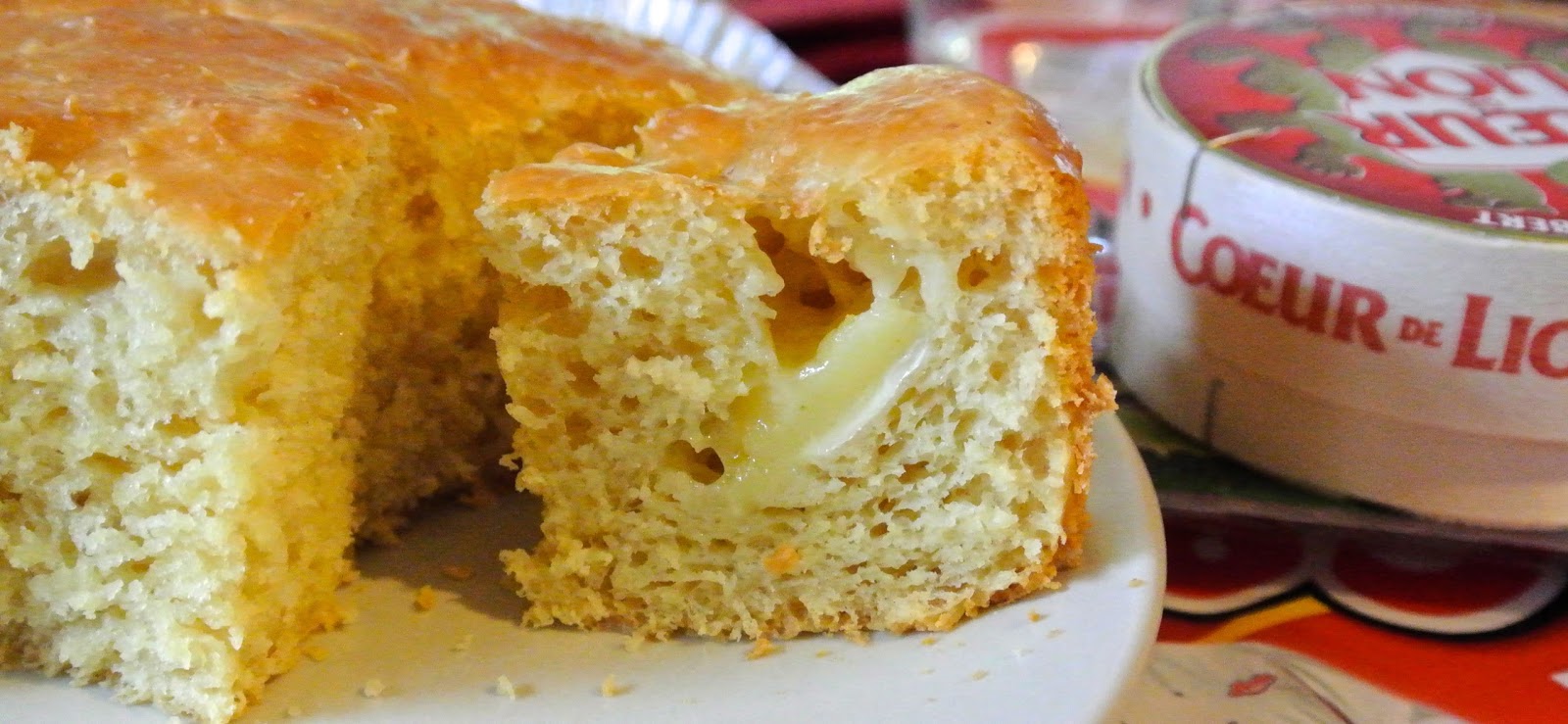
Camembert brioche

For the apple version, grease a baking sheet. Knock your dough back a bit and divide it into two. Either roll or push each one into a round shape on the baking sheet.

You’ll need to make a crème patissiere to go on top of the dough. In a bowl, combine 100g sugar, 4 medium egg yolks and 40g of cornflour until they are smooth. Heat 500ml of whole milk and a teaspoon of vanilla bean paste in a pot until boiling. Pour about a quarter of this into the egg yolk mixture and whisk. Then add this mixture back into the milk in the pot and heat the whole lot until it starts thickening. Pass this through a sieve and mix through a 40g knob of butter. Cover this with a circle of greaseproof paper to prevent a skin from forming. Leave this to cool.

When it’s cool, spread the crème on the dough – I only needed about half of it, which was fine, as this was the best custard I’ve ever eaten. And I’ve eaten a lot of custard.

The 'creme pat' on the brioche

Peel, core and slice about 3 apples and arrange these on top of the crème patissiere. If you have some, sprinkle a few slivered almonds on top. Bake this at 200° for 20-25 minutes until it is golden brown. You could brush the top with apricot jam to glaze it. I don’t like apricots, so I didn’t.

And spread with the apples

I didn’t try this, but I think some fried lardons would work well in the cheesy ones (and I’d add a bit more cheese, so maybe 150g cheese instead of 100g), and an apple and Brie version would be delicious. Hmmm, I might have to make this a third time…


Sunday, 15 September 2013

Brussels Clandestine Cake Club – meeting #2; le rentrée

With a theme of 'back to school', the five bakers, two eaters and three kids faced this rentrée with maybe a bit more enthusiasm than the other one.

Dutch apple cake, without the salted caramel sauce

We each baked childhood treats or cakes with a clever twist – an ‘apple for the teacher’ Dutch apple cake (with salted caramel sauce), sticky toffee cake, bakewell cake, a Swedish strawberry cheesecake, a marble cake and chocolate-filled brioche – an Italian childhood staple. The sharp eyed amongst you will notice that one enthusiastic baker had baked two cakes!

Marble cake

All participants were reinforced with either strong cups of Barry’s (Irish) tea or glasses of Sprite, depending on their age.

Bakewell cake

And so down to the eating. At first, there wasn’t a lot said, as everyone was too busy going ‘mmmmm’ and ‘nomnomnomonom’. After the first platefuls were consumed we shared the details behind some of the cakes, be they granny’s recipes, family favourites or simply brought back happy memories.

A loaded plate!

Round 2: we each loaded up our plates again or moved on to the next cake on the table, sharing baking tips and eating tips (“you have got to try this one”). This time the ensuing silence came from over-indulgence. Break time and time for a refill of the tea cups.
We all managed to have a third tour de table, waistbands groaning. By the end, each of the cakes was decimated, and there wasn’t a lot left to take home.

The Swedish strawberry cheesecake


The next meeting will take place at the beginning of November, probably the 2nd, but this is TBC. If you would like to come along, email me, Katie, at brusselsCCC@gmail.com.


Italian chocolate-filled sourdough brioche rolls

Sunday, 24 March 2013

Sunday brunch – homemade brioche


We had freshly baked brioche for brunch this morning. It was melt-in-the-mouth delicious, and very, very light. I made the dough yesterday, so all I had to do was pop it in the oven when I got up.

Brioche

I used Paul Hollywood’s recipe from ‘how to bake’. It is seriously good. I’ve made a few recipes from the book now, and all have worked perfectly and taste great.

You will need:
500g strong, white flour
7g of salt
50g of castor sugar
10g of instant yeast
140ml of warm, full fat milk
5 medium eggs
250g of soft, unsalted butter

Get your mixer out, and add the flour to the bowl. Put the salt and sugar to one side and the yeast to the other. Pour in the milk and the eggs, and mix on a slow setting for about two minutes. Turn up the power to medium and mix at this speed for another 6-8 minutes, until your dough is elastic and soft.

Cut your butter up into squares and add this to the dough, mixing it well for about another five minutes. Stop the mixer every now and again to scrape down the sides. Make sure that the butter is well mixed though. Your dough should be smooth and very soft. I’ve been trying to think of what the texture is like. This was my first time making a rich dough. All I can think of is, it reminds me of soft butter. The colour and smell were divine, and the texture was very soft.

Tip the dough into a plastic container. I’m usually quite open to interpreting recipes (sometimes very liberally), but the recipe says a plastic container, so I followed it to the letter. I don’t know if you could keep it in the mixing bowl and get the same results (mine is metal). If you know better than I do, let me know in the comments below! Cover the dish and chill it for at least seven hours.

After the seven hours, the dough had metamorphasised. The squishy dough had firmed up significantly and it was much easier to manipulate.

You’ll need to grease a 25cm round tin at this stage. It doesn’t need to be lined.

Flour your work surface and tip your dough out onto it. Fold it over onto itself a couple of times to knock some of the air out. Divide it into nine similar-sized pieces. Eight of these can go around the edge of your tin, and the ninth goes into the centre.

Balls of brioche, ready to prove

Cover this with a clean plastic bag or clingfilm and leave it to prove for another 2-3 hours. I did all of this on Saturday afternoon and left the dough to prove overnight in my kitchen. Your dough should rise again.

When you’re ready to bake, heat your oven to 190°c. Bake your dough for 20-30 minutes – mine took about 35 minutes. When it’s done, put it on a wire rack to cool for a bit. We ate ours still warm from the oven with raspberry jam.

Baked brioche